

Too close, life disappears.
Too far, life freezes.
Position determines possibility.
In October of 1995, two astronomers announced something that permanently changed humanity’s understanding of the universe.
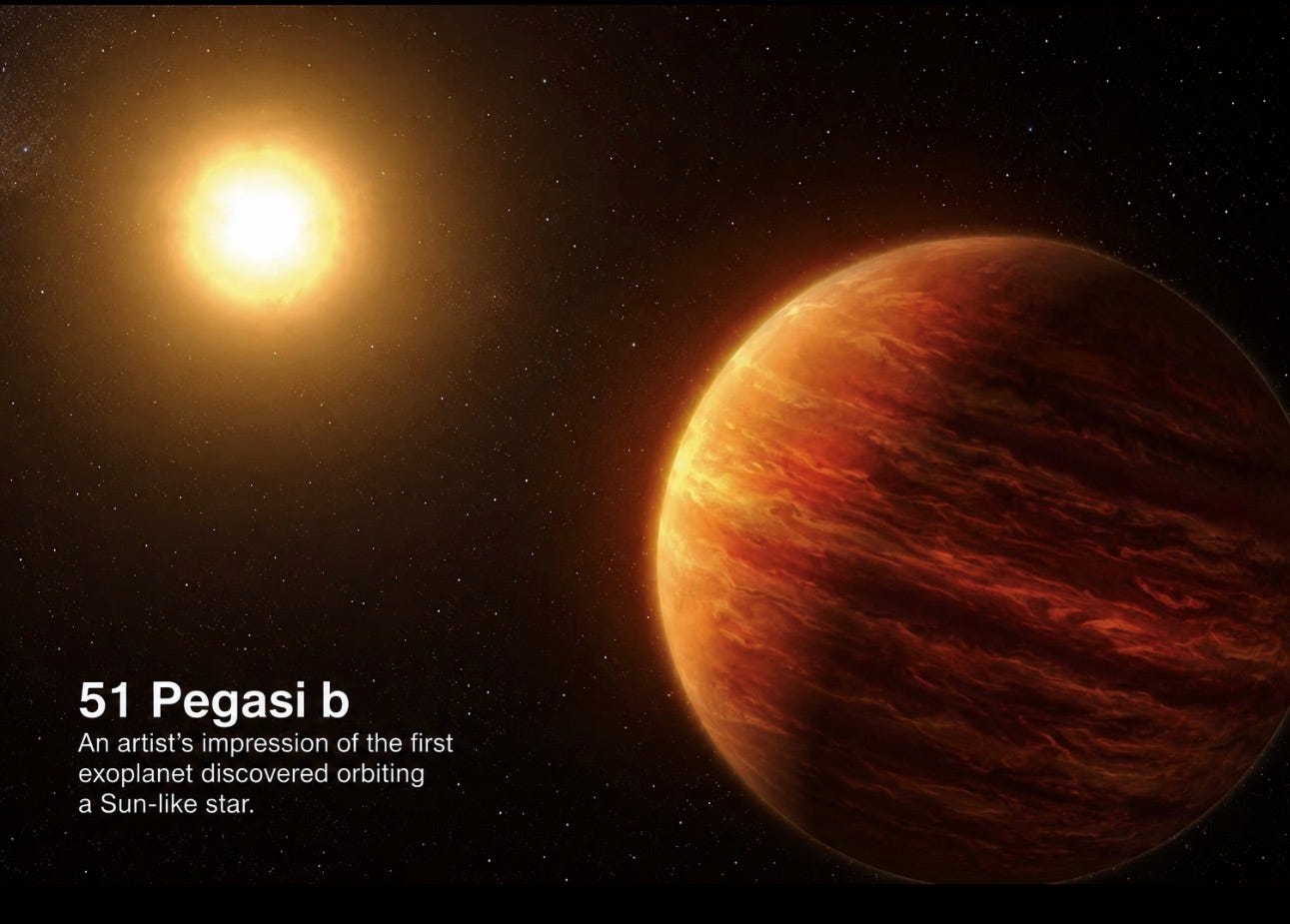
For the first time in recorded history, scientists confirmed the existence of a planet orbiting a star outside our solar system.
The planet was named 51 Pegasi b.
At first, the discovery sounded almost hopeful. Another planet. Another world. Another possibility somewhere beyond Earth.
But as scientists studied it more closely, the excitement slowly transformed into something else.
The planet was not where it was supposed to be.
51 Pegasi b orbited so close to its star that one complete year lasted only about four Earth days. Temperatures were extreme. Atmospheric winds moved violently across the planet. The environment was so unstable that scientists later classified it as a “Hot Jupiter,” a giant gas planet existing in conditions far too intense for life as humans understand it.
The discovery forced astronomers to confront an uncomfortable reality.
A planet can contain enormous mass, structure, and complexity — and still become hostile because of its position.
Not because it lacked substance.
Because it existed too close to the wrong thing.
Astronomy already had a name for the opposite condition: the Goldilocks Zone. The narrow region around a star where temperatures are neither too hot nor too cold, allowing liquid water and potentially life itself to exist.
Too far away, planets freeze into silence.
Too close, they collapse into instability.
Between those extremes lies a fragile position where sustainability becomes possible.
The universe itself operates on positioning.
What makes this idea unsettling is how familiar it feels in human life.
Two people can possess similar intelligence, discipline, and ambition while experiencing completely different outcomes over time. One gradually grows inside an environment that supports development. Another slowly burns out despite equal effort.
Modern culture teaches people to focus almost entirely on internal qualities:
work harder,
be more productive,
stay consistent,
push further.
But nature itself suggests that effort alone is incomplete.
A person can apply extraordinary energy while remaining in the wrong environment, the wrong career path, the wrong relationship, or the wrong system entirely. Over time, exhaustion becomes interpreted as weakness when the deeper issue may simply be positional misalignment.
The universe does not reward intensity alone.
Even planets depend on placement.
Earth itself is not perfect. Storms exist. Droughts exist. Extinction events exist. Yet Earth occupies a position that continuously allows recovery, balance, and sustainability over long periods of time.
Position creates possibility.
The Goldilocks Zone is more than an astronomical concept. It is a reminder that potential alone is rarely enough. Conditions matter. Environment matters. Distance matters. Placement matters.
Sometimes the difference between growth and collapse is not capability.
It is position.
Sources
NASA — Habitable Zone / Goldilocks Zone
Nobel Prize — Discovery of 51 Pegasi b
European Space Agency — Exoplanet Research