

Everyone has heard the classics.
“Do what you love.”
“Follow your passion.”
“Find your niche.”
The advice sounds meaningful. It fills graduation speeches, productivity videos, and LinkedIn captions. And yet for many people, it quietly fails.
Not because the advice is malicious.
Because it skips the one thing that actually determines where most people end up:
Positioning.
The Invisible Competition Nobody Talks About
A strange realization hits almost everyone the moment they enter the real world:
There are a lot of people exactly like them.
Same degree. Same certifications. Same portfolio projects. Same online courses. Same career goals. Sometimes, even the same personality is packaged in slightly different words.
This is not accidental.
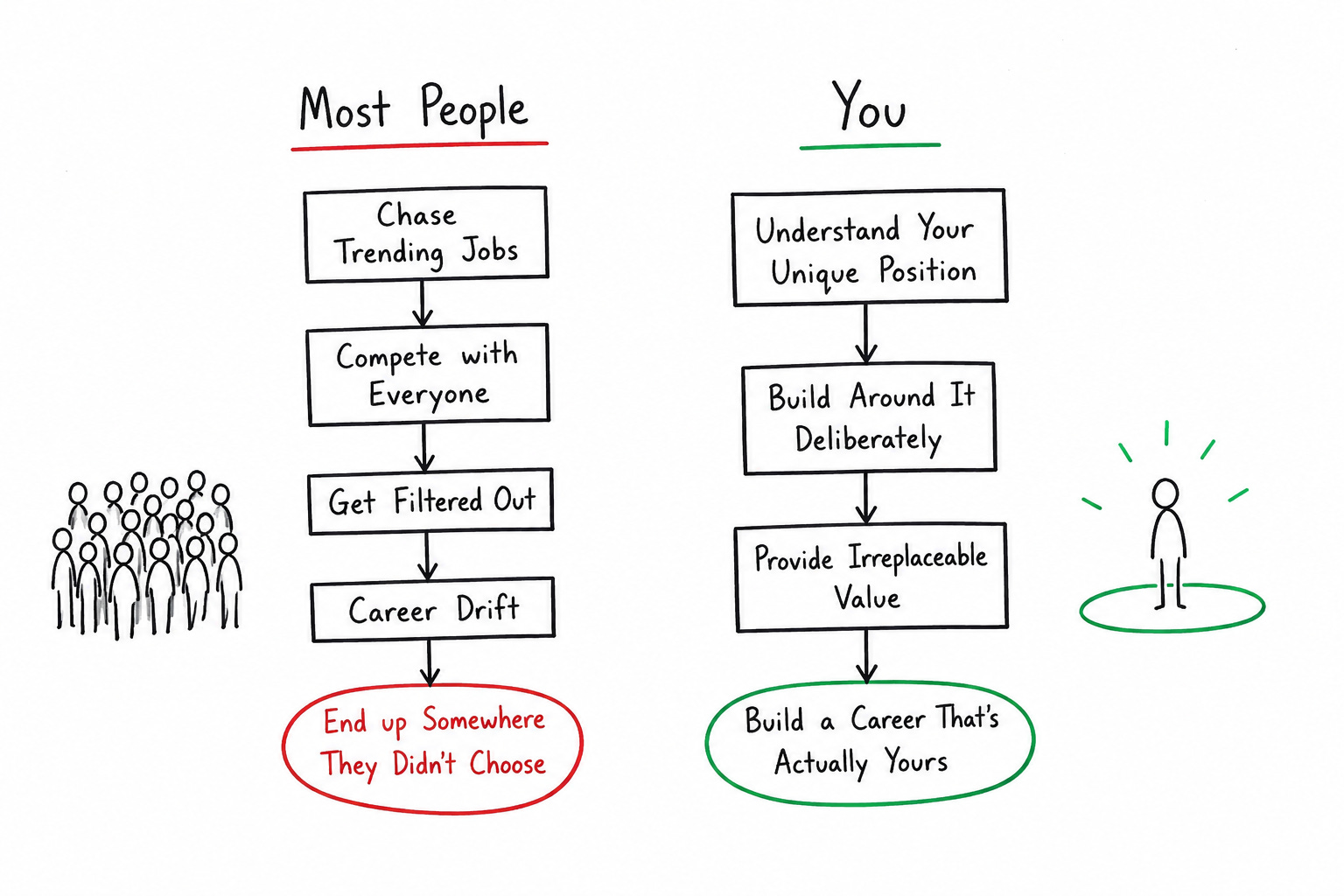
Most people unconsciously position themselves around trends before they ever understand themselves.
When someone is young and trying to figure out life, they rarely ask:
“What position in the world am I uniquely built to occupy?”
Instead, they ask:
“What job pays well right now?”
So they chase whatever the market currently rewards.
One decade, it is finance. Then, software engineering. Then UX. Then data science. Then AI.
The role changes. The pattern does not.
The assumption is simple:
“If I can reach this role, I can finally build the life I want.”
And sometimes that works.
But millions of people are trying to enter the same doorway at once.
The Career Drift Nobody Plans For
Most careers are not intentionally designed.
They are reactions.
Someone fails to land their first target role, so they pivot into something adjacent. Then another adjacent role. Then another compromise.
Not because they are incapable.
Because survival requires adaptation.
Over time, many people slowly drift into careers shaped less by deliberate positioning and more by elimination.
They become whoever was left after the market finished sorting everyone else.
That is the part nobody warns you about.
The original goal was never truly the job title itself.
The goal was freedom.
Security.
Meaning.
Respect.
Income.
Autonomy.
Those outcomes could have been achieved through multiple paths.
But trend-driven thinking narrows people into competing for the same visible routes, while ignoring the positions they may naturally dominate.
What Happens When You Position Yourself First
Imagine approaching your career from an entirely different angle.
Instead of asking:
“What role is trending?”
You ask:
“What combination of experiences, thinking patterns, skills, obsessions, and perspectives makes me structurally different?”
That question changes everything.
Because companies do not actually operate on generic job titles.
They operate through positions.
Distinct functions.
Distinct responsibilities.
Distinct trust.
Distinct context.
Even when two people appear to have the same job, they rarely occupy the same position.
Take two janitors in the same building.
Same title.
Same pay grade.
Same uniform.
But one works mornings while the other works nights.
One knows the executives personally.
One handles emergency requests.
One understands the building’s hidden operational problems.
One has informal influence over how things get done.
On paper, identical.
In reality, completely different positions.
No functioning organization contains perfectly interchangeable people.
There is always a remaining difference — sometimes small, sometimes massive — that separates one person from another.
That remaining difference is where identity lives.
And identity is what creates irreplaceability.
Positioning Is Not “Finding a Niche”
This is where people misunderstand the idea.
Positioning is not the same as “finding your niche.”
A niche is often market-first thinking.
You search for an opportunity gap and try to fit yourself into it.
Positioning works in reverse.
It starts with understanding your actual structural uniqueness first, then building deliberately around it.
That means recognizing a few uncomfortable truths:
1. You Already Have a Position
Even if you never consciously define it, the world eventually will.
Your habits position you.
Your reputation positions you.
Your strengths position you.
Your weaknesses position you.
Your environment positions you.
The only real question is whether you are intentionally shaping that position or passively inheriting one.
2. Trends Expire Faster Than Identity
The hottest career path today may become saturated tomorrow.
Technology shifts.
Markets shift.
Industries shift.
But deep positioning compounds.
A person with rare judgment, unusual perspective, cross-domain thinking, operational understanding, or unique communication ability often survives market shifts better than someone built entirely around trend participation.
3. Differentiation Is Structural
Most people treat differentiation like branding.
Better resumes.
Better aesthetics.
Better self-promotion.
But real differentiation is structural.
You cannot outperform someone occupying the same ground forever.
Eventually, competition becomes compression.
The real advantage comes from standing in a different place.
The Question Most People Avoid
So here is the uncomfortable question:
If every person with your exact job title disappeared tomorrow, what would be lost that only you could uniquely replace?
Not your company.
Not your role description.
You.
Your thinking.
Your perspective.
Your pattern recognition.
Your ability to connect things that others cannot.
If the answer feels unclear, that is not a failure.
It is awareness.
Once you see that gap clearly, you can finally begin positioning intentionally rather than reactively.
Your career was never supposed to be built entirely around trends, titles, or whatever the market temporarily rewards.
It should be built around the most defensible thing you actually possess:
A position that is genuinely yours.
First.