

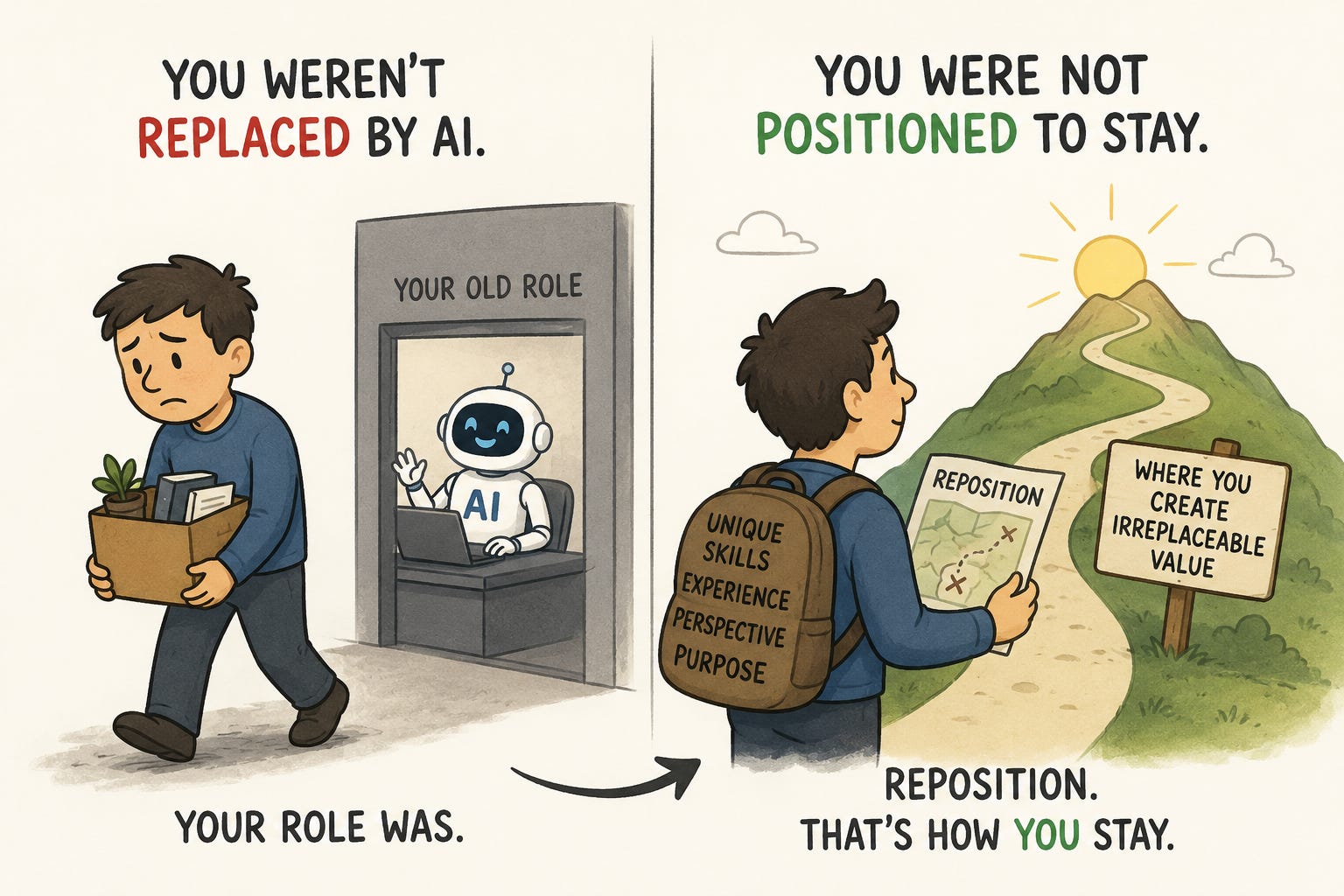
Scroll through LinkedIn or Twitter on any given day, and you will find them — people in tears. Professionals with decades of experience. Fresh graduates who have just started. People who did everything right, followed every rule, and built careers they were proud of. And now they are staring at a screen, writing posts that begin with “After X years at…” with shaking hands.
The pain is real. The fear is real. The confusion is real.
And if that is you right now, this article is for you.
What the Numbers Actually Say
Let’s start with what is actually happening, because the noise around AI and jobs is deafening, and most of it is either panic or dismissal.
The World Economic Forum’s 2025 Future of Jobs Report found that 41% of employers globally plan to reduce their workforce in areas where AI can automate tasks within the next five years. ¹ Research estimates that between 200,000 and 300,000 U.S. jobs were displaced or not created in 2025 alone due to AI, and most of that never shows up in official layoff data. ⁵ It happens quietly: someone leaves, and the company simply doesn’t replace them.
In Big Tech, new graduate hiring dropped 25% in 2024 compared to the year before. ² Entry-level white-collar roles — sales, administration, legal support, market research — are among the most exposed. One analysis found that AI could automate over half of market research analyst tasks and two-thirds of sales representative tasks. ⁴
The numbers are real. The disruption is real.
But here is what the numbers also say: in 2024, AI-related hiring reached approximately 119,900 new jobs, while confirmed AI-driven losses were about 12,700. ³ The World Economic Forum projects that by 2030, while 92 million roles may be displaced, 170 million new roles will emerge — a net gain of 78 million jobs. ¹
AI is not ending work. It is ending certain positions. And that difference matters more than most people realize.
The Harder Truth Nobody Is Saying
Here is what I want to say carefully, with full empathy, because I know this stings:
Most of the positions being eliminated were not truly permanent to begin with.
That is not a criticism of the people in them. It is a criticism of how we were taught to think about work.
We were taught that a “permanent position” means security. That if you keep your head down, do your job, don’t make waves, you will be fine. Permanence was the promise. Show up, stay loyal, and the company will take care of you.
But a company’s first obligation is not to its employees. It is for its survival. And when a company can replace a function with software — when the output is the same, but the cost is a fraction — that function was never as permanent as we believed.
This is not new. Automation has been doing this for decades. AI is just faster, smarter, and reaching white-collar work for the first time.
The painful reality is this: if your value to an organization could be fully replicated by a tool, the organization would eventually choose the tool. Not because you weren’t good. But because you were positioned as a function, not as a person with irreplaceable judgment, relationship, and unique ability.
The question is not “why did AI replace me?”
The question is: “Was I positioned to be irreplaceable?”
This Is Not a Restart. This Is a Repositioning.
If you have been laid off, I need you to hear something clearly:
This is not starting over. This is starting from somewhere.
You have years of experience. You have knowledge that took time to build. You have instincts that no model has trained on. You have relationships, context, and a perspective shaped by your unique life.
None of that disappeared when your badge stopped working.
What happened is that the position you occupied no longer needed a human to fill it. But you are not in a position. You are a person. And persons cannot be deprecated.
The work now is repositioning—not rebuilding from scratch, but deliberately placing yourself where your unique abilities actually matter. Where you cannot be replicated. Where the world actually needs what only you can give.
Here is how to start:
1. Remember what you are genuinely great at. Not your job title. Not your responsibilities. What do people always come to you for? What do you do that feels effortless but amazes others? Start there.
2. Find a gap. One gap. Not a business plan. Not a five-year vision. Just one problem in the world around you that you are uniquely positioned to help solve. It could be small. It should be specific. Solve it for one person first.
3. Start where you can start. Not where you wish you could start. Not at the level you used to be at. Start at the level reality allows right now. One conversation. One project. One step. Momentum is built from motion, not from waiting for the perfect moment.
4. Build slowly. Build solidly. Repositioning is not a sprint. It is a deliberate, steady process of putting yourself in places where your specific value is visible and needed. Each step compounds.
The World Needs You Positioned, Not Paralyzed
Here is the bigger picture.
We are living through one of the most significant economic transitions in human history. And in the middle of transitions, there are two kinds of people: those who react, and those who reposition.
Reacting looks like anger at the companies, despair at the future, and waiting for someone to fix it.
Repositioning looks like asking: Where do I actually belong? What can I contribute that the world cannot get from a machine? How do I place myself there, intentionally?
Every single person has a unique combination of experience, perspective, empathy, and ability that no AI can replicate. The problem is that most people never discovered what they truly were — because they never had to. The system rewarded showing up. Now the system is changing, and the people who will thrive are the ones who finally ask the question that was always worth asking:
Where is my position in this world?
If every one of us found that answer — and showed up there — imagine what becomes possible. Not just for our own careers. But for the communities, organizations, and problems we could actually transform.
This is not about surviving AI.
This is about finally becoming irreplaceable.
Position First is a publication about moving through the world with intention. If this resonated with you, share it with someone who needs it. We change the world when we help each other find our position.
— Position First
Sources
World Economic Forum — Future of Jobs Report 2025 https://www.weforum.org/publications/the-future-of-jobs-report-2025/
SignalFire Research (via Final Round AI) — Big Tech Graduate Hiring Decline 2024 https://www.finalroundai.com/blog/ai-replacing-jobs-2025
High5Test — AI Replacing Jobs Statistics U.S. 2024–2025 https://high5test.com/ai-replacing-jobs-statistics/
DAVRON — AI Job Replacement Statistics 2025–2030 https://www.davron.net/ai-job-replacement-statistics-2025-2030/
Dave Shap / Substack — AI Destroyed 200k to 300k Jobs in 2025 in the US
